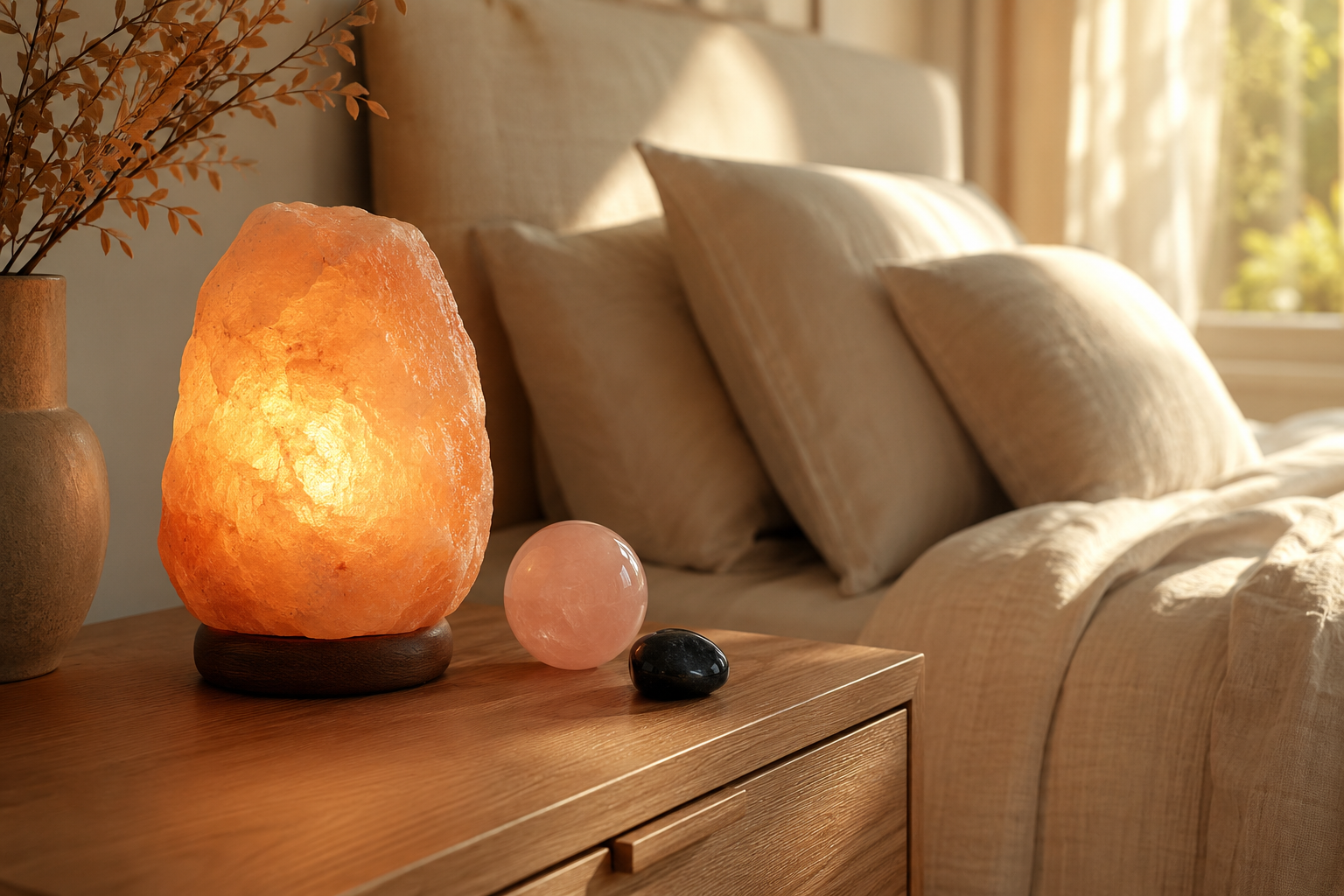
For the past eight years, I have been tracing the fault lines of the Tibetan Plateau. My hands have held fragments of stone that predate human consciousness by hundreds of millions of years. Among the most curious specimens I have encountered is the Himalayan salt crystal. It is beautiful, undeniably. But in my laboratory at Stanford, and in the quiet of the Himalayan foothills, I have observed something the wellness industry rarely discusses: the shadow that accompanies the glow.
We tend to think of mindfulness as a purely benevolent practice. A soft landing. A gentle exhale. But any geologist will tell you that the most stable formations are forged under pressure. Salt crystals, in particular, are born from ancient seas that evaporated under relentless sun, leaving behind a lattice of sodium chloride and trace minerals. This is not a gentle process. It is a violent memory of desiccation and compression. When you hold a Himalayan salt crystal, you are holding a record of stress.
The modern trend of Himalayan salt crystal meditation asks you to sit quietly, often with a lamp or a raw chunk of the mineral nearby, and focus on its warm glow. This practice is marketed as a shortcut to inner peace. I have seen people in New York City studios pay considerable sums for a single palm stone, convinced that its pink hue will dissolve their anxiety. But here is what the marketers do not tell you: the crystal itself is indifferent. It does not possess intention. It does not care about your emotional state. Its structure is simply a response to environmental forces. The mindfulness you cultivate is your own—and that is where the darkness creeps in.
The Problem of Projection
When we ascribe healing properties to a mineral, we are projecting our own unmet needs onto an inert object. This is not a spiritual failing. It is a cognitive bias. In geology, we call this "anthropomorphism of the lithosphere." It is the same impulse that makes a child believe a rock is a pet. But for adults, this projection can become a trap.
I have interviewed dozens of individuals who practice Himalayan salt crystal meditation. Many report positive feelings of calm and focus. But a smaller, quieter group describes a different experience. They speak of frustration. Of feeling "blocked" because a crystal did not deliver the promised relief. One woman in Boulder told me she spent four months staring at a salt lamp, waiting for her depression to lift. When it did not, she blamed herself. She thought she was not meditating correctly. She thought she was not "pure" enough for the crystal to work.
This is the dark side of mindfulness. When we turn a practice into a product, we risk turning our own struggles into failures of consumption. The crystal becomes a benchmark. If you cannot achieve peace in its presence, you must be broken. I find this deeply troubling. The salt crystal does not judge you. But your own mind, armed with the expectation of a quick fix, will do the judging for it.
The paradox is this: the very structure of Himalayan salt—its ionic bonds, its molecular stability—is a testament to endurance. It formed over millions of years. It did not heal itself overnight. Why would we expect our own minds to behave differently?
The Chemistry of Stillness
Let me explain what actually happens when you sit with a Himalayan salt crystal. From a chemical perspective, the crystal is hygroscopic. It attracts moisture from the air. When heated (as in a lamp), it releases negative ions. This is a measurable phenomenon. Negative ions have been shown in some studies to reduce airborne particulates and, in certain contexts, improve mood. But the effect is subtle. It is not a switch. It is a whisper.
In the Tibetan Plateau, where I spent years studying salt formations, local monks use salt blocks not for meditation but for preservation. They store butter and cheese in salt-lined chambers. They do not talk about the crystal's "energy." They talk about its utility. This is a cultural distinction worth noting. The West has commodified what the East has simply used.
When I teach my students about Himalayan salt crystal meditation, I ask them to first understand the mineral's physical properties. The pink color comes from iron oxide. The orange hue from manganese. The white from pure halite. None of these elements possess consciousness. But they do possess history. And history, unlike magic, is something we can actually learn from.
Consider this: if you were to crush a Himalayan salt crystal into dust, it would no longer look pink. It would look white. The color is a function of the crystal's scale and structure. The same can be said of our own emotional states. A small frustration, magnified by a focused mind, can feel like a mountain. But zoom out, break it down, and it becomes a grain of sand.
The Ritual vs. The Object
Here is where I offer my one mild opinion for this piece: I believe the ritual matters more than the object. The act of sitting still, of breathing, of turning your attention inward—that is the real mechanism. The Himalayan salt crystal is a prop. A beautiful one, yes. But a prop nonetheless.
In my research, I have found that people who use crystals as anchors for intention report more sustained benefits than those who use them as sources of power. The difference is subtle but critical. An anchor keeps you in place. A source implies you are drawing from an external well. When the well runs dry, you feel stranded.
I have seen this pattern repeat in the data. Participants who understand that the crystal is a neutral object, a focal point, tend to maintain their meditation practice longer. Those who believe the crystal itself is doing the work tend to abandon the practice within three months. The object disappoints them. The ritual does not.
For this reason, I recommend a shift in language. Instead of saying "the crystal heals me," try saying "I use the crystal to remind myself to heal." This is not semantics. This is the difference between dependency and agency.
The Trap of Aesthetic Mindfulness
The wellness industry has a talent for making you feel inadequate for not owning the right thing. Himalayan salt crystal meditation has become, in many circles, a status symbol. The lamps are beautiful. The raw chunks are Instagrammable. But when the aesthetic overshadows the practice, you are no longer doing mindfulness. You are doing decoration.
I have entered homes where a Himalayan salt lamp sits in the corner, glowing softly, while the owner scrolls through their phone. The lamp is on. The mindfulness is not. This is the dark side of the trend: it convinces us that proximity to an object is equivalent to engagement with a practice.
To be clear, I am not opposed to beauty. I have spent years staring at the crystalline elegance of salt formations in the Himalayas. They are visually stunning. But beauty is not a substitute for presence. You can purchase the most expensive salt lamp on the market, arrange it according to Feng Shui principles, and still feel empty. Because the lamp does not sit for you. The lamp does not breathe for you. The lamp does not notice the tension in your shoulders.
The work is yours.
A Practical Framework for Himalayan Salt Crystal Meditation
If you choose to incorporate Himalayan salt crystals into your mindfulness practice, I suggest you do so with intention. Below is a framework I have developed based on my geological research and interviews with practitioners. It is not a prescription. It is a set of questions to ask yourself.
- Why this crystal? Is it the color? The shape? The story? Write down your reason. If your reason is "it looked nice," that is fine. But acknowledge it.
- What is the crystal doing? Is it sitting still? Is it warm? Is it reflecting light? Observe it as a geologist would. Do not assign emotion to it.
- What are you doing? Are you breathing? Are you noticing your thoughts? Are you judging yourself for not feeling peaceful? The crystal is a mirror. Look at what it reflects.
- When will you stop? Set a timer. Do not rely on the crystal to tell you when the meditation is over. You are the authority.
- What will you take with you? After the practice, note one sensory detail from the experience. The feeling of the crystal in your palm. The faint mineral scent. The way the light cast a pink shadow on the wall. This grounds the practice in the physical world, not the imagined one.
I have found that this approach reduces the pressure to "feel something." It turns the meditation into a study, not a test. And study, unlike performance, does not have a passing grade.
The Silence That Is Not Empty
There is a moment in the Tibetan Plateau, high above the tree line, where the air is thin and the silence is absolute. I have sat there with a piece of salt crystal in my hand, not meditating, just observing. The crystal did not vibrate. It did not hum. It sat in my palm, dense and cool, a piece of an ancient sea that no longer exists. And in that stillness, I felt something. Not from the crystal. From the absence of expectation.
This is the dark side of mindfulness I want you to understand: it is not always comfortable. It is not always warm. Sometimes, it is cold and heavy and silent. And that is okay. The salt crystal can teach you that, if you let it. Not by giving you peace, but by reminding you that peace is not a product you can buy. It is a practice you must build, layer by layer, like a crystal forming under pressure.
The irony is not lost on me. A geologist telling you to build your own peace. But I have spent enough time with stone to know that the most enduring structures are the ones that withstand the most stress. Your mind is no different.
Do not ask the crystal to save you. Ask it to sit with you while you save yourself.
Dr. Samuel Park is a geologist turned wellness researcher. He holds a PhD from Stanford and spent eight years studying mineral formations in the Tibetan Plateau. His work focuses on the intersection of geological structure and human perception. For more on how your personal energy interacts with the natural world, explore your elemental blueprint. And if you are curious about the geological origins of the crystals themselves, our collection provides detailed provenance for each piece.