I remember the first time a Tibetan mineralogist placed a clear quartz point in my palm, high in a village perched on a ridge in the Spiti Valley. The wind was thin and cold, carrying the scent of juniper smoke from a nearby hearth. He didn't tell me to meditate with it. He told me to close my eyes and listen to the stone. Not with my ears, but with the quiet space behind my thoughts.
I was twenty-four then, fresh from university with a geology textbook understanding of crystals. I knew about the repeating atomic patterns, the hexagonal symmetry, the silicon-oxygen tetrahedra that form the backbone of quartz. But that day, sitting on a worn yak-hair blanket, I learned the difference between knowing a fact and feeling a truth.
The truth is this: every crystal is a structure of nearly perfect order. Its atoms lock into a repeating geometric grid that, under ideal conditions, extends uninterrupted for millions of years. This grid—what scientists call the crystal lattice—is not static. It vibrates at a specific frequency determined by its atomic spacing and bonding angles. And this, I have come to believe after twelve years of walking these mountains and sitting with these stones, is where the deepest connection to mindfulness begins.
The Science of Silence and Order
Let me offer a simple image. Imagine a vast ballroom filled with dancers. In most materials—wood, plastic, your morning coffee—the dancers move chaotically, bumping into one another, shifting positions, never settling into a pattern. This is the atomic reality of amorphous solids and liquids. Now imagine that same ballroom, but every dancer has been placed in a precise grid, each one equidistant from the next, all moving in the same slow, synchronized sway. That is a crystal lattice.
The crystal lattice vibrations of a Himalayan quartz crystal operate at a frequency that falls within the range of what physicists call the terahertz gap. This is not a mystical claim. It is measurable. These vibrations arise from the thermal energy stored in the bonds between atoms—gentle, rhythmic oscillations that persist as long as the crystal exists. They are not loud. They are not dramatic. They are the whisper of order in a universe that tends toward entropy.
When I teach workshops in California, I often see students arrive with a certain expectation. They want a lightning bolt. They want a sudden shift. But the crystal does not offer a shock. It offers a reference point. When you hold a piece of Himalayan quartz, you are holding a fragment of the planet that has been vibrating in the same precise pattern for perhaps 500 million years. That is a patience we cannot manufacture in our own nervous systems.
A Personal Encounter with the Lattice
I recall a morning in a village called Malana, deep in the Parvati Valley. The miners there have worked the same seams for generations. They do not speak of frequencies or quantum physics. They speak of the stone as something that "remembers." One old man, his hands stained with iron oxide from decades of extracting crystals, told me that the stone holds the memory of the mountain's birth. He did not mean this in a literal, biological sense. He meant that the crystal's structure, its unbroken lattice, is a record of pressure, heat, and time.
He showed me a crystal that had been damaged by a blast—a fracture running through its body. The lattice was broken. The vibration, he said, was now "confused." He placed it aside, not to be sold, but to be left in a stream for a season, where the constant flow of water might help it settle. I do not know if the water can truly repair a fractured lattice at the atomic level. But I know that his respect for the integrity of the structure taught me something about my own internal fractures.
When we sit in meditation, our minds are often like that broken crystal. Our thoughts fracture in a dozen directions. The lattice of our attention is cracked by anxiety, planning, regret. We vibrate chaotically. To hold a crystal with an intact lattice is to borrow its order for a moment. Not to absorb it, but to observe it. To let its steady, measurable vibration become a metronome for the breath.
Using Lattice Awareness in Mindfulness Practice
I want to offer a method I have developed over years of teaching, grounded in the physics of crystal lattice vibrations rather than in any esoteric belief. This is not a ritual in the traditional sense. It is a practice of attention.
Begin by sitting in a comfortable posture. Take a piece of Himalayan crystal—any variety will do, though a single-terminated point is easiest for this exercise—and hold it in your non-dominant hand. Close your eyes. Do not try to feel anything. Do not wait for warmth or tingling. Instead, direct your attention to the physical reality of the stone.
Consider the following:
- The stone is a solid. Its atoms are locked in place. It cannot move on its own.
- The stone is cold at first because it is a better conductor of heat than your skin. Your hand will warm it over time.
- The stone has mass. You can feel its weight in your palm.
- The stone has a surface texture, even if polished. Run your thumb across it. Notice the micro-irregularities.
- The stone has a shape determined by its internal lattice structure. The angles of its faces are not arbitrary. They are the external expression of the atomic grid within.
Now, shift your attention to the space between your thoughts. This is the difficult part. Instead of focusing on the stone as an object, focus on the fact that the stone is still. It does not rush. It does not worry. Its only activity is the slow, subatomic vibration that has been occurring since before humans existed. You are holding something that has been doing the same thing for longer than you can conceive. You are not trying to become the stone. You are using its stillness as a contrast to your own mental motion.
I hold a mild opinion here, one I have earned through personal practice: I believe that the human mind cannot achieve true stillness by force. It can only achieve stillness by resting against something that is already still. The crystal lattice provides that resting place. It is not a tool for escape. It is a tool for contrast. When you feel the solid, ordered presence of the crystal in your hand, your own chaos becomes visible. And visibility is the first step toward ease.
The Geometry of Attention
The repeating pattern of a crystal lattice is a form of physical music. Each mineral species has its own "note"—a specific spacing between atoms that determines how it interacts with light, heat, and pressure. Himalayan quartz, for example, has a trigonal crystal system. Its atoms are arranged in a spiral of silicon and oxygen that twists along a central axis. This is not merely decorative. It means that the crystal has no center of symmetry. It is inherently polarized.
This polarization is what allows quartz to generate a small electrical charge under mechanical stress—the piezoelectric effect. But for our purposes, the polarization offers a more subtle lesson. The crystal has a direction. It has an orientation. When you hold a terminated point, you can feel that one end is "finished" and the other is "rooted." This is not a metaphor. It is a geometric fact.
In mindfulness meditation, we can use this directional quality. Point the terminated end away from your body. Imagine that your attention, like the crystal, has a direction. You are not trying to empty the mind. You are trying to orient the mind. The lattice of the crystal offers a template for this orientation. It tells the attention: here is a structure you can follow. Here is a pattern that repeats. You do not need to invent order. You only need to align with it.
I have seen students in my workshops who struggle with traditional breath meditation. They find the breath too subtle, too fleeting. But when I ask them to hold a crystal and simply notice its existence as a solid object with a known internal structure, their faces change. The jaw relaxes. The shoulders drop. They have found an anchor that does not float away.
A Note on the Himalayan Origin
The crystals I work with come from the region between the Indian subcontinent and the Tibetan plateau. This is not a marketing detail. It is a geological fact that affects the crystal lattice itself. The Himalayan range was formed by a collision of tectonic plates that began approximately 50 million years ago and continues today. The pressure involved in this collision is immense. It compresses the crystal lattices in ways that crystals from other regions do not experience.
When a crystal is formed under high pressure and relatively low temperature, its lattice is more tightly packed. There are fewer defects. The vibrational frequency becomes more consistent. This is not a value judgment—crystals from Brazil or Arkansas are beautiful and useful in their own right. But the Himalayan crystals possess a particular coherence that I associate with their violent, slow birth.
I think of this when I sit with a piece of quartz from a mine at 14,000 feet. The mountain that produced it is still rising. The pressure that shaped its lattice is still active. There is something humbling in holding a structure that was refined by forces that could crush a human body without effort. It puts my own small anxieties into perspective. My worry about an email, my frustration with traffic—these are not problems for a crystal lattice that has survived continental collision. The crystal does not dismiss my feelings. It simply offers a different scale of reference.
Practical Integration into Daily Life
You do not need to sit in formal meditation to work with crystal lattice vibrations. The principle can be integrated into ordinary moments. When I feel my attention scattering during a conversation or while reading, I sometimes pick up a small crystal from my desk. I hold it for ten seconds. I do not close my eyes. I simply let my hand register the weight, the texture, the coolness. This brief sensory check-in recalibrates my nervous system.
The lattice of the crystal is still vibrating. I cannot hear it. I cannot feel it. But I know it is there. And that knowledge is enough to remind me that there is order in the universe, even when my own thoughts are disordered. The crystal does not fix me. It witnesses me. And sometimes, being witnessed is what we need to return to ourselves.
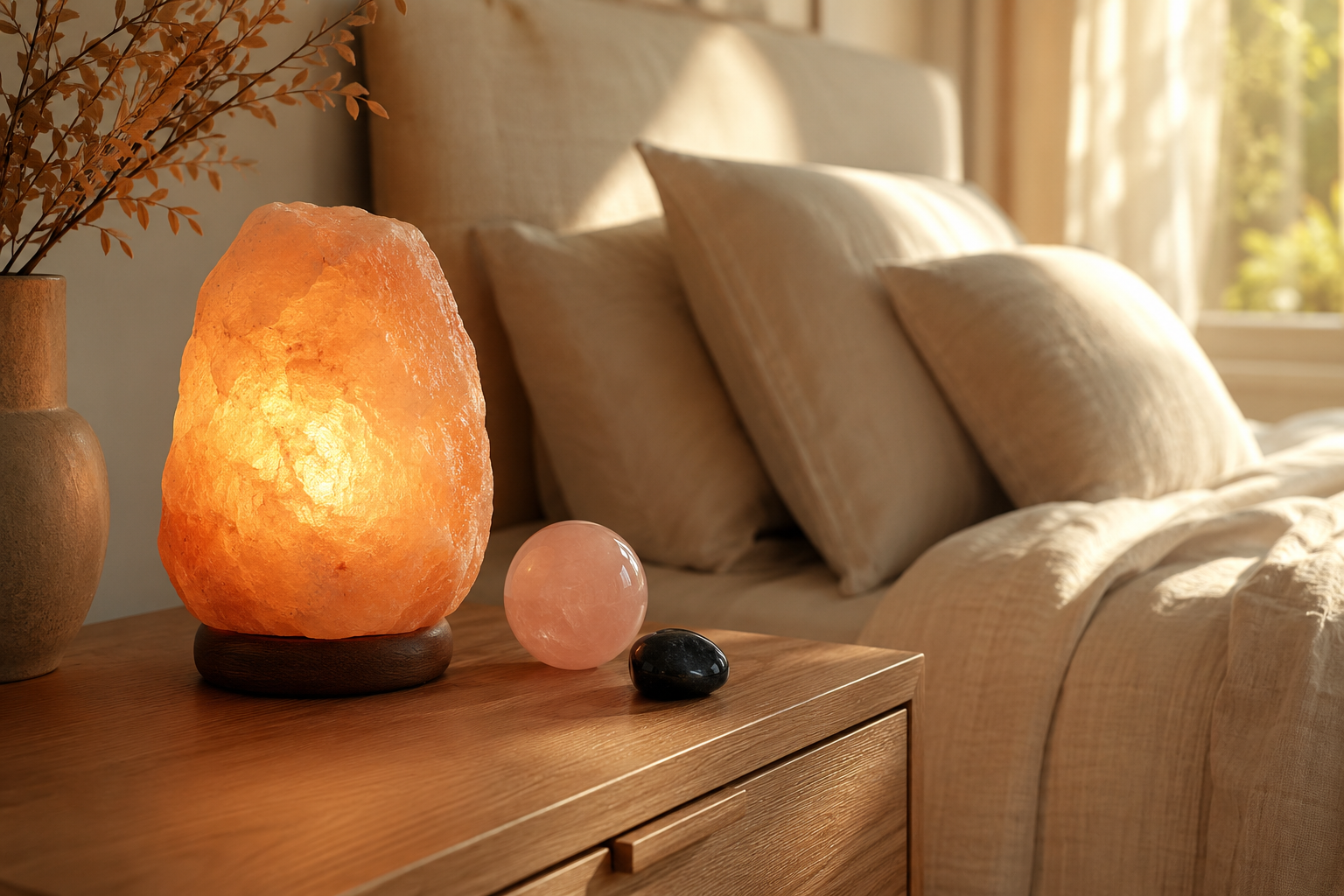
I also find this practice useful before sleep. I place a small crystal on my bedside table. Before I turn off the light, I hold it for one minute. I do not try to clear my mind. I simply acknowledge that this object has been vibrating in a stable pattern for millions of years, and that I, too, can allow my nervous system to settle into its own natural rhythm. It is not a cure for insomnia. It is an invitation to rest.
The Deeper Blueprint
If you are interested in exploring how the specific elemental composition of Himalayan crystals relates to your own energetic structure, I have written a longer guide called your elemental blueprint. It explores the relationship between crystal chemistry and human constitution, drawing from Tibetan mineralogical traditions. The ideas in that guide are not intended as medical advice, but as a framework for self-inquiry.
For those who wish to experience these crystals firsthand, you are welcome to explore our collection. Each piece is sourced from the Himalayan region with attention to lattice integrity. But I will say this: the most important crystal you will ever work with is the one that calls you to sit still. The rest is detail.
Closing Thoughts
I have spent more than a decade walking among miners and mountains, learning to see the world through the lens of mineral structure. I have learned that a crystal is not a magic object. It is a physical fact. Its beauty lies not in what it can give us, but in what it already is: a pattern of order that has persisted through unimaginable time and pressure.
When you sit with a crystal, you are not performing a ritual in the conventional sense. You are aligning your attention with a structure that has been practicing stillness since before your ancestors walked upright. The crystal lattice vibrations are not a secret. They are physics. They are geometry. They are the slow, patient music of the earth.
And that music, if you listen with the quiet space behind your thoughts, can teach you something about your own capacity for peace. Not a loud, triumphant peace. A quiet one. A peace that repeats, like a lattice, moment after moment, until it becomes the structure of your own awareness.
Mira Kadam is a crystal practitioner with 12 years of fieldwork in the Himalayan region. Trained under Tibetan mineralogists and now teaches crystal workshops in California.